For nearly two centuries, a single Quaker family transformed Darlington from a modest market town into the cradle of the railway age. The Pease dynasty shaped not only the town's physical landscape but also its moral character, leaving a legacy that remains visible throughout Darlington today.
The Wool Merchants Who Bet on Steam
The Pease fortune began in wool. Edward Pease, born on 31 May 1767, joined his father's woollen business at age fifteen. The family were prominent Quakers, and their faith would prove inseparable from their commercial success. Pease Partners Bank, founded by Edward's father Joseph Pease in 1761, provided the financial foundation for ventures that would eventually change the world.
The pivotal moment came in 1818. Edward Pease attended a public meeting at Darlington Town Hall on 13 November where the idea of a railway was proposed. He promised a five per cent return on investment and subscribed £7,000 of his own money, more than any other backer. The Stockton and Darlington Railway was born.
The World's First Steam Railway
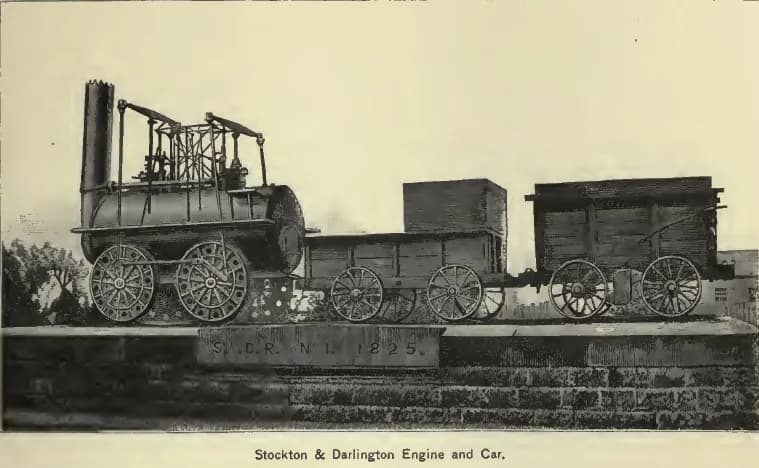
On 27 September 1825, history was made. Locomotion No. 1, built by Robert Stephenson and Company (in which Pease was a principal), hauled a train carrying between 450 and 600 passengers from Phoenix Pit to Stockton. The engine reached speeds of fifteen miles per hour. It was the world's first public railway to use steam locomotives.
Edward Pease's contribution extended beyond money. When the project faced financial difficulties in 1826, he advanced funds twice to pay the workers. His extensive connections within the Quaker banking community proved essential to the railway's success. Jonathan Backhouse of Backhouse's Bank served as treasurer, and the majority of the managing committee were Quakers.
Edward retired in 1829, having secured his investors a five per cent dividend, which rose to eight per cent by 1832. He died on 31 July 1858 and was buried at the Friends Burial Ground on Skinnergate.
The Railway Statesman
Edward's second son, Joseph Pease, took the helm in 1829 and managed the railway with considerable acumen. He became the largest owner of collieries in South Durham by 1830 and, together with his father-in-law Joseph Gurney and other Quaker associates, purchased five hundred acres at Middlesbrough to develop as a coal port. The railway line to Port Darlington opened on 27 December 1830; within a year, the town's population grew from a handful of houses to more than two thousand.
Joseph Pease entered Parliament in 1832, becoming the first Quaker permitted to take his seat. He refused to swear the traditional oath, affirming instead, and maintained his Quaker principles by refusing to remove his hat even in the House of Commons. He introduced the Cruelty to Animals Act 1835, which banned bear-baiting and cockfighting, and served as President of the Peace Society from 1860.
Gifts to the Town
Joseph Pease's generosity to Darlington was substantial. In 1864, he presented the town with its iconic Clock Tower, which formed part of the Old Town Hall and Market Hall complex designed by Alfred Waterhouse in the Gothic style. The entire complex cost £7,815. The clock face was made by T. Cooke & Sons of York, and the bells were cast by John Warner & Sons, sisters to the bells of Big Ben.
A statue of Joseph Pease was unveiled in 1875 at the junction of High Row and Bondgate, marking the golden jubilee of the Stockton and Darlington Railway's opening. It stands there still.
The Mayor and the Seaside Town
Henry Pease, Edward's fifth son, served as a director of the Stockton and Darlington Railway and became Darlington's first Mayor in 1867. He is best remembered for founding Saltburn-by-the-Sea, transforming a remote stretch of Yorkshire coast into a planned Victorian seaside resort. Like his relatives, he was deeply committed to the Peace Society and visited Czar Nicholas I in 1854 in an unsuccessful attempt to avert the Crimean War. He died on 30 May 1881.
Learning and Liberation
The Pease family believed in education for all, including women. Elizabeth Pease Nichol, daughter of Joseph Pease (1772–1846), received the same education as her male cousins at a Quaker school. She became a leading abolitionist, founding the Darlington Ladies Anti-Slavery Society, and supported women's suffrage and anti-vivisection campaigns.
In 1853, Elizabeth donated £400, the largest single contribution, towards the £2,300 cost of the Darlington Mechanics Institute. She officially opened the institute on 1 September 1854. The building at 82 Skinnergate still stands today.
Edward Pease (the younger) continued the family's educational philanthropy, building Darlington Free Library at a cost of £10,000. It opened on 23 October 1885 and was presented to the town council to operate in perpetuity. The Grade II listed building in Crown Street still houses the library and a centre for local studies.
Quaker Ethics in Commerce
The Pease family embodied what historians have called "Quaker capitalism." Their faith prohibited involvement in the slave trade, gambling, and the production of armaments. They promoted temperance, prison reform, and the abolition of slavery. Joseph Pease (1772–1846), brother of Edward, founded the Peace Society in 1817.
These principles did not hinder commercial success. The family established businesses spanning wool, banking, railways, locomotive manufacturing, and mining. They developed Middlesbrough into a model industrial town and Saltburn into a planned resort. Their Quaker networks provided capital, trust, and shared values that proved essential to their ventures.
The Legacy Today
Walk through Darlington today and the Pease influence is everywhere. The Clock Tower still marks the hour above the Market Hall. The statue of Joseph Pease stands watch at High Row. The Free Library continues to serve readers on Crown Street. South Park, the first Victorian park in North East England, opened in 1853 with financial support from the Backhouse family, Quaker bankers connected to the Peases through marriage.
The railway heritage endures at the Head of Steam museum at North Road station, where Locomotion No. 1 was once displayed. The Skerne Bridge, built in 1825 and designed by Ignatius Bonomi, still carries trains across the River Skerne. David Mach's "Train" brick sculpture near the A66 commemorates the town's railway history.
The Pease dynasty faded in the twentieth century. Backhouse's Bank merged with Barclays in 1896. The railway works closed in 1966. But the town they built remains. From wool merchant to railway pioneer, from abolitionist to parliamentarian, the Pease family left an indelible mark on Darlington: a town built by Quaker faith, industrial ambition, and an enduring commitment to the public good.